Workshop prepares parishes to cultivate vocations
Friday, Nov. 21, 2025
IC photo/Linda Petersen
+ Enlarge
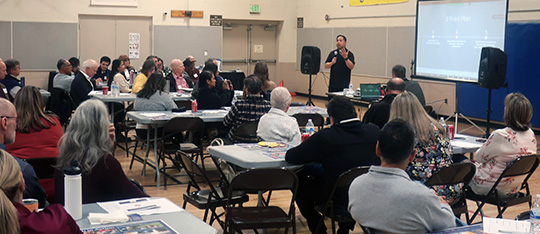
Father Carlos Guzman, RCJ, the diocesan vocations director, speaks during the Nov. 15 Hundredfold vocations ministry workshop.
SALT LAKE CITY — Catholics from across the Diocese of Salt Lake City came together Nov. 15 for a daylong workshop to learn to nurture vocations in their parish or mission.
The Hundredfold vocations ministry workshop at St. Ann Catholic Church in Salt Lake City included Bishop Oscar A. Solis celebrating a bilingual Mass, during which he welcomed the participants by saying, “We gather to celebrate this Eucharist during this Hundredfold workshop of increasing vocations in our diocese, vocations of the priesthood, religious life and sacramental marriage. As the diocese is implementing our Pastoral Plan, it is our primary priority and prayer that we increase a culture of vocations in Utah.”
As people of God, everyone is called to become a vocation promoter, he said. “What a beautiful gesture of your generosity to come and participate in this wonderful movement that we want to create in the Diocese of Salt Lake City to promote vocations to the priesthood, religious life and the sacrament of marriage.”
During the workshop, concurrent sessions were held in English and Spanish in the church and the Kearns-St. Ann Catholic School gymnasium, which is adjacent to the church.
In the first English session, presenter Bob McMorrow of Vocation Ministry noted that the Catholic Church is experiencing a severe vocation shortage. In the United States over the past 10 years, ordinations to the priesthood and the number of young men entering the seminary have dropped by more than 25 percent, he said.
Compounding this problem is that many of the priests now in active ministry are aging: 50 percent of priests in many dioceses are near retirement age, he said, and many parishes do not have a priest to serve them.
There has also been a significant decrease in Catholic marriages, he said. “Young adults, 40 percent of them, see no value in traditional marriage.”
In the face of this reality, the old ways of just expecting vocations to religious life and sacramental marriage to happen naturally in a place “that’s chaotic and noisy” and “attacking the faith” don’t work anymore, he said.
However, increasing vocations can occur through what he called “intentional ministry,” which begins with building stronger families, then working to support and encourage young people who are actively involved in the Church to consider the priesthood or religious life.
He pointed to a study conducted by Vocation Ministry in the Diocese of Austin, Texas that found that 80 percent of seminarians came from only 20 percent of parishes – those with a vocation ministry.
“We want to create our parishes with the immersion experience that our young people can’t help but have this idea come to them,” he said.
In his second session, McMorrow shared some resources and ideas for organizing effective vocations ministry teams. He encouraged participants to use those resources to start their efforts, even if only in a small way, and to persevere through challenges as they continue the process.
“God is excited in your ministry. ... You’re going to have all sorts of sabotage,” he said. “We can’t get discouraged when things don’t go well.”
Each parish or mission should adapt the program to make it work for its population and needs, McMorrow said.
Later, Father Carlos Guzman, RCJ, the diocesan vocations director, outlined the diocesan goals for vocations ministry. The goals follow.
Everyone is a vocations promoter.
“Don’t think that this is just an issue that the diocese has to [handle]...,” Fr. Guzman said. “You are invited to work. You are invited to come up with results.”
Efforts must be coordinated
Vocations ministries in parishes and schools, such as faith formation and youth programs, should be aligned with the diocese’s direction and given priority to find and ordain more priests, he said.
Prayer for vocations must be a priority.
Toward this end, Fr. Guzman encouraged each parish to have a Holy Hour for vocations.
“When we are people gathered together in prayer, in one intention, our prayer is only heard because the sound is greater… and the sincerity of the prayer [is greater] because it is shared by each and every member,” he said.
Fr. Guzman encouraged workshop participants to actively nurture young people who may have a calling by involving them in parish life and providing opportunities for them to hear God’s voice. Vocations often begin in schools and homes, he noted.
Many of those who attended the workshop were inspired by what they heard, they said.
“I learned that we should start small together, build teams that will help us succeed, and not to give up,” said Brenda Gonzales, who is an Extraordinary Minister of Holy Communion and Order of Christian Initiation of Adults instructor at St. Joseph Parish in Ogden.
After the workshop, “We need to be more intentional about bringing the youth to make them aware of the opportunity of this vocation,” said Daniel Lowe, who is involved with the youth ministry at St. Ambrose Parish in Salt Lake City.
Among those attending the Spanish portion of the workshop were the Fernandez family, Tomas, Mairy and their daughters Maria Gabriela and María Veronica, who are parishioners at St. Andrew Catholic Church in Riverton.
“We are really surprised at the need that we have in our diocese, and learning all the work that our priests have, everyone should step up and serve as much as we can,” Mairy Fernandez said.
For questions, comments or to report inaccuracies on the website, please CLICK HERE.
© Copyright 2026 The Diocese of Salt Lake City. All rights reserved.
© Copyright 2026 The Diocese of Salt Lake City. All rights reserved.
Stay Connected With Us