Presentation give overview of Church history
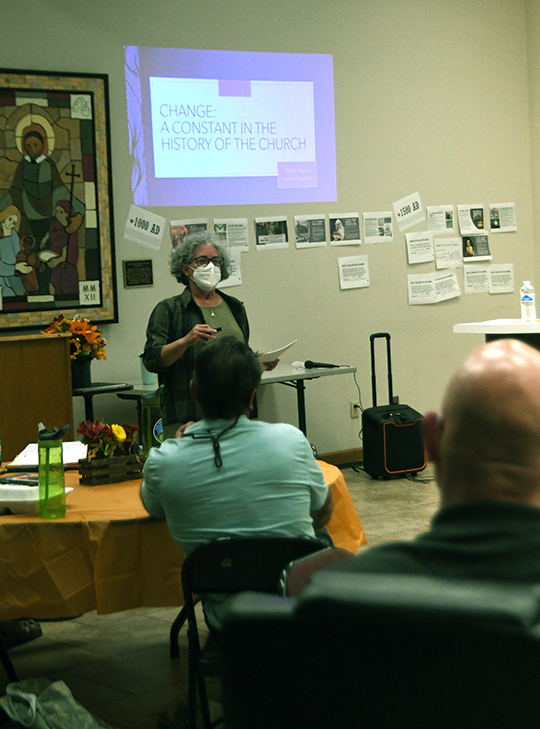
SALT LAKE CITY — From the early Church, when survival was a priority for followers of The Way; to the Council of Trent, when the Sacrament of Communion and a homily were optional during the Mass; to Vatican II, which called for full and active participation of the laity and frequent reception of Communion, the history of the Church was painted in broad strokes during a Sept. 25 presentation to the English-speaking class of the lay ecclesial minister formation program.
“Any lay ecclesial minster must have a good background in Church history and understand that the Church is continually progressing,” said Susan Northway, the director of the diocesan Office of Faith Formation, who oversees the program.
The four-year LEM program takes participants through topics such as Scripture, Catholic social teaching, morality, spirituality and leadership skills. Those who complete the program serve in various roles in their parish and in the diocese, such as teaching religious education or participating in youth ministry. This is the fourth cohort of English-speaking LEMs in the diocese; there also have been two cohorts in Spanish.
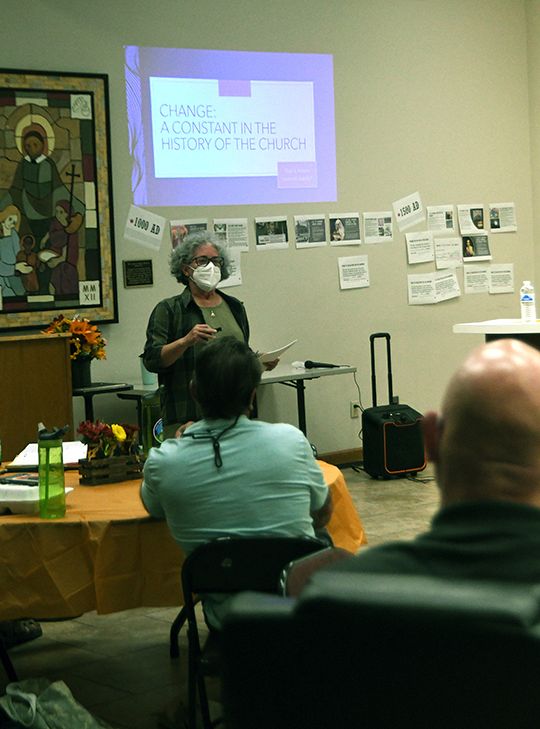
During the Sept. 25 presentation at St. Vincent de Paul Parish’s Benvegnu Center, Deana Froerer and Julie Boerio-Goates presented numerous turning points in Church history. Both Froerer and Boerio-Goates are commissioned LEMs; Froerer teaches economics at Weber State University and also teaches at the DaVinci Academy of Science and the Arts, while Boerio-Goates taught chemistry at Brigham Young University before she retired.
Froerer introduced some necessary vocabulary, such as ecclesiastical, encyclical, schism and synod, before beginning with early Church history. In the years immediately following the Crucifixion, staying alive was a priority for the early Christians – persecution was real but “a slew of martyrs enlivened the ‘Church on the run,’” she said on a slide.
The first Church Council was held in Jerusalem in AD 50, when the Apostle Paul and Barnabas and some of the Gentile Church members journeyed to Jerusalem to meet with Peter and James about circumcision, as described in the Acts of the Apostles. The council decided the Mosaic custom of circumcision didn’t need to be followed; that this was a secondary issue, so a compromise on it could maintain peace and unity in the emerging Church, Froerer said.
The Edict of Milan in 313 ended state-sanctioned persecution of the early Christians in the Roman Empire. The edict granted all people freedom to worship whatever deity they pleased, assured Christians equal rights and directed prompt return of Christians’ confiscated property – this allowed Christians to gain political influence and build assets, Froerer said.
In addition to detailing important Church councils such as those in Nicea in 325, that in Chalcedon in 451 and that in 1139 in Lateran, Froerer briefly touched on several influential figures: Augustine of Hippo, Athanasius, Thomas Aquinas, and the four women Doctors of the Church.
In her presentation, Boerio-Goates spoke of how the rulings from the various councils led to the structure of the Church and the liturgy that exist today. The goal of her presentation, she said, was for her audience “to see the present rooted in the past, with the councils, the schisms, the synods, papal supremacy vs. conciliarism, church/state power.”
The Council of Jerusalem set precedents: the call to settle conflicts by meetings of ecclesiastical leaders, that Church leaders were to invoke and accept the inspiration of the Holy Spirit, and that Scripture and Tradition were to underpin discussions at the councils, she said.
The Church inherently has a position of both/ and, not either/or, she said: for example, accepting both the Bible and the book of nature, and viewing the Eucharist as both a communal meet and a renewal of the sacrifice on Calvary.
At the Council of Trent, the number of sacraments offered by the Church was set at seven, and the ritual of the Mass was formalized so there was uniformity. Details of church architecture also were described: the altar and tabernacle were to be fixed against the eastern wall of the church, and the laity were separated from the sanctuary by a Communion rail.
While the Council of Trent allowed a Mass at which both the homily and Communion were optional, the Second Vatican Council called for full and active participation by the laity in the Mass as well as having Communion offered at every Mass. Resulting from Vatican II were 16 documents – four constitutions, nine decrees and three declarations – which spoke of a universal call to holiness, a call to study Scripture in groups and privately, and the Mass in the vernacular, Boerio-Goates explained.
As both presentations showed, change is a constant in the history of the Church, Boerio-Goates said, and she urged those in the class to participate in the local discussions for the synod called for by Pope Francis that will begin in October.
© Copyright 2026 The Diocese of Salt Lake City. All rights reserved.
Stay Connected With Us