Our Lady of Lourdes student claims top prize at science fair
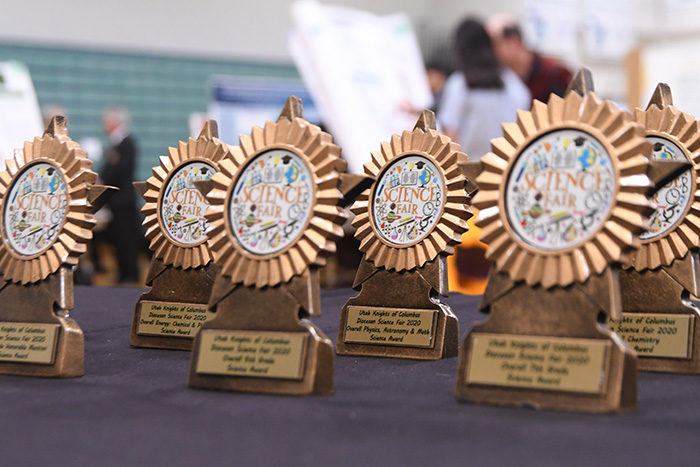
SALT LAKE CITY — During the winter, Elliott Bucher’s family uses grow lights to cultivate indoor flowers around their home, a practice that prompted the Our Lady of Lourdes Catholic School eighth-grader to study how the color of light affects plant growth for his Diocesan Science Fair project.
Elliott, 14, ended up being surprised in two ways by his project: his hypothesis proved to be false, and he was named the Young Scientist of the Year at the science fair.
In his project Elliott made the assumption that red light would beat out blue light in terms of ensuring taller plants, but the opposite proved to be true. In all cases except one, blue light led to the most growth because it carries more energy to deliver to the plant due to the short distance of the light wavelengths from peak to peak, Elliott explained.
To examine the effect of light on plant growth, Elliott used his family’s 3-D printer to manufacture three containers that housed nine cubes in which he planted seeds. He then used a separate grow light for each container. The lights shone for nine hours each day for 26 days. Every day, Elliott observed each plant and made notes.
Elliott said through the process he learned more about growing plants and, in particular, how light affects plant growth. He also learned how to be patient because he measured the plants on a daily basis, he said.
In addition to teaching scientific methods, participating in the science fair has helped Elliott to develop his speaking skills, he said. “When I’m in front of a bunch of people I usually mumble. [At the science fair] I enunciated clearly, and I’ll probably use that going forward.”
When he arrived at the fair, he took stock of his competition and was impressed by several other projects, which he didn’t expect to beat, he said. In fact, because he was focused on getting to a hockey game that day, Elliott almost missed the science fair awards ceremony. However, his science teacher, Joshua Hegvik, suggested to Elliott’s mother that it would be a good idea if the family stayed, Hegvik said.
Elliott has several characteristics that may have helped him succeed at the fair, Hegvik said.
“Elliott is a very thoughtful, reserved kid who thinks about his answers very carefully before he gives them, and I think that he enjoys history and science and he participates often,” Hegvik said. “He is on task always, which is a pretty remarkable trait for kids these days ….”
While Elliott might not have had the showiest project at the science fair, “When you talk to him about the knowledge of the project and of the scientific principles, he knew his stuff well,” Hegvik said. “The substance of what he was explaining to the judges was the key, and I think that shined through with his project. I think what stood out with him was more his oral presentation, his explanation of why things were happening the way they were, and his breaking down of his project.”
Elliott, the middle child of three brothers, plans to attend Judge Memorial Catholic High School, then hopes to go on to the University of Pittsburgh, his parents’ alma mater, and become a doctor or possibly an attorney.
This is the second consecutive year that an Our Lady of Lourdes student claimed the Young Scientist award; last year’s winner was Chase Kramer. Also this year, OLOL seventh-grader Catherine Eagar took first place in her grade level in the Medicine, Health Science, Biomedical Engineering category.
Hegvik is not surprised by these accomplishments. “We have smart, bright kids who are invested in their education and their parents are invested, and I think that attributes to our Catholic schools in general,” he said. “We like to foster a love of trying to figure things out and doing science. They get to use the science labs as middle-schoolers at Judge and that helps them open their eyes to different opportunities in science.”
© Copyright 2026 The Diocese of Salt Lake City. All rights reserved.
Stay Connected With Us