National Eucharistic Pilgrimage in Utah: Parishes host processions, Adoration for pilgrims
Editor’s note: This is part one of a two-part series on the Utah leg of the National Eucharistic Pilgrimage, which was in the Diocese of Salt Lake City May 31-June 5.
SALT LAKE CITY — The National Eucharistic Pilgrimage entered Utah on May 31 after a ceremonial handoff from Bishop Peter Christensen of Boise to Father John Evans, who in August will become the Diocese of Salt Lake City’s vicar general. Fr. Evans accepted the handoff following Mass at St. Peter’s Catholic Church in Preston, Idaho.
Among the Diocese of Salt Lake City representatives who joined Fr. Evans in Preston were Father Christopher Gray, the diocesan point person for the National Eucharistic Revival; Fr. Rojelio Felix-Rosas and Fr. Robin Cruz, pastor and parochial vicar, respectively, of St. Thomas Aquinas Parish in Hyde Park, which was the pilgrimage’s first stop in Utah; Fr. Joshua Santos, pastor of St. Joseph Parish in Ogden; Fr. Francisco Pires, pastor of St. Henry Parish in Brigham City; Fr. Joseph Minuth, administrator of Holy Family Parish in South Ogden; and Maria Cruz Gray, director of the Office of Hispanic Ministry.
The pilgrimage is one of the culminating events of the three-year National Eucharistic Revival, which the U.S. Conference of Catholic Bishops called for beginning in 2022 “to inspire and prepare the People of God to be formed, healed, converted, united, and sent out to a hurting and hungry world through a renewed encounter with Jesus in the Eucharist – the source and summit of our Catholic faith,” according to eucharisticrevival.org.
The pilgrimage had four starting points, one at each of the cardinal directions of the continental United States. The St. Junipero Serra route, which came through Utah, began in San Francisco, Calif.
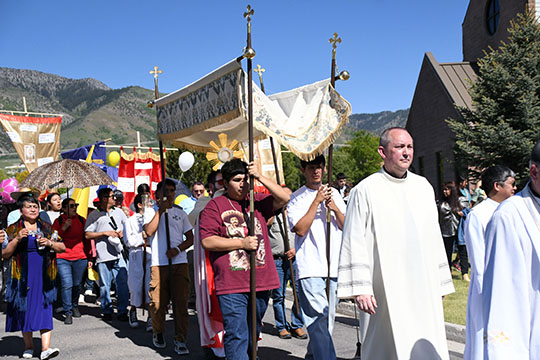
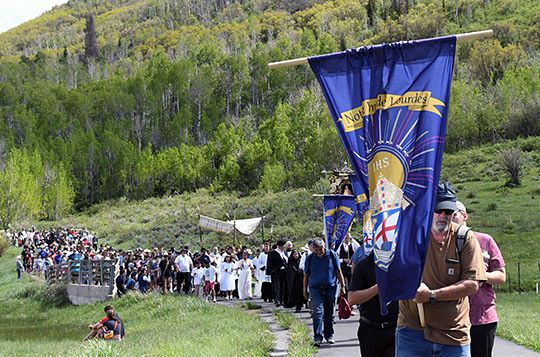
In Utah, the first pilgrimage-related event was a two-mile Eucharistic procession in Hyde Park that ended at St. Thomas Aquinas Catholic Church. About 150 people took part, pausing five times along the way to pray at stational altars for specific intentions such as youth, vocations and senior ministry.
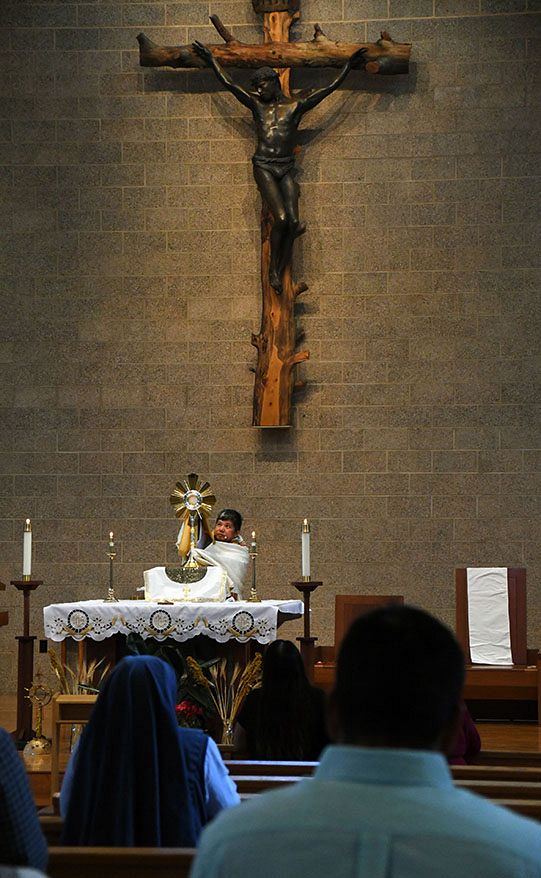
They then continued the procession, singing and praying in English and Spanish, until they entered the church property, singing “Pan de Vida.” They were welcomed by parishioners bearing balloons who lined the driveway. Following Mass, the parish hosted an all-night Adoration of the Blessed Sacrament.
Having the pilgrimage at the parish was a gift, Fr. Felix-Rosas said in an interview, because “it is like having Jesus at the house.”
For Deacon Jim Miller, one of those who carried the monstrance in the procession, the experience “took my breath away,” he said, especially “being surrounded by all those people who actually believe in Jesus Christ, and not just give lip service to it. … I can’t put it into words; it was just something else. … The feeling was just overwhelmingly positive.”
Fr. Evans, who joined the procession, said that along the way he saw a man who was not part of the event kneel on the grass as they passed. “I knew that he understood the profound moment that was upon him … and he knelt, and he put God first in that moment,” Fr. Evans said in his homily the following Sunday at his parish.
“The whole point of the Eucharistic rally is to bring awareness to the Eucharist, especially in the True Presence,” and the man who knelt was an example of someone who understood that truth, Fr. Evans said. “It was a moment of grace for him.”
The faith of the people participating in the pilgrimage stands out, agreed Brother Juan Francisco, CFR, one of the Franciscan Friars of the Renewal who accompanied the national pilgrims through Idaho and into Utah. “It has been a great journey for me just to see of the country,” not only in big cities but also in small towns. Even people who are not deeply catechized “have a heart for the Lord,” he said.
“I’m going home tired but very renewed in my faith,” he said.
For Chas Firestone East, one of the national pilgrims, the first two weeks on the road has exposed him to different practices in the Mass and Adoration. A convert to Catholicism, he has experienced Church practices in the northeastern United States and in Europe. In both places Mass and Adoration are usually done mostly in silence, he said. However, from California to Utah he regularly attended Masses that were bilingual English-Spanish, and Adoration often included singing and a homily, he said.
These may seem like minor variances, but “cultural differences really stick out when you’re used to one mode at all times,” he said.
“It’s a good reminder that your way is not the only way,” he said, adding that “there are multiple ways of showing reverence, and just because something might be distracting for you, or you might not respond to it, does not de facto mean that it is for someone else irreverent or distracting.”
A graduate student at Columbia University, East said that during the pilgrimage he has expanded his prayer practices to include lectio divina and the Liturgy of the Hours. His hope is that the fruits of the pilgrimage will include many conversions to the faith and a mass return to the Church, he said, and he has seen hopeful signs of this. Already on each route of the pilgrimage stories of conversion are emerging, he said, and at each stop he has seen people filling the churches.
East urged Catholics to, through their behavior, “be something that starts a question” that could lead to conversion, he said.
The June 21 Intermountain Catholic will have Part 2 of this story, which will report on the June 2-4 events in Summit County, Salt Lake City and the Uinta Basin.
© Copyright 2026 The Diocese of Salt Lake City. All rights reserved.
Stay Connected With Us